This Month’s Poems

Green the land of my poem, Mahmoud Darwish ‘Green the land of my poem is green and high Slowly I tell it slowly with the grace of a seagull riding the waves on the book of water I bequeath it written down to the one who asks to whom shall we sing when salt poisons the dew?’

Green the land of my poem by Mahmoud Darwish read by John Glenday

Poetry speaks to our common humanity and our shared values, transforming the simplest of poems into a powerful catalyst for dialogue, thought and peace.

This month we feature recordings made for World Poetry Day by poets reading favourite poems from Poems on the Underground. We also feature poems to celebrate Shakespeare’s birthday on April 23rd and Spring Poems

Listen to all the World Poetry Day Recordings

Free, Merle Collins 'Born free to be caught and fashioned and shaped and freed to wander within a caged dream of tears'

Free read by Merle Collins

Accordionist, George Szirtes ' The accordionist is a blind intellectual carrying an enormous typewriter whose keys grow wings as the instrument expands into a tall horizontal hat that collapses with a tubercular wheeze. My century is a sad one of collapses. The concertina of the chest; the tubular bells of the high houses; the flattened ellipses of our skulls that open like petals. We are the poppies sprinkled along the field. We are simple crosses dotted with blood. Beware of the sentiments concealed in this short rhyme. Be wise. Be good.'

Accordionist read by George Szirtes

I Sing of Change Niyi Osundare I sing of the beauty of Athens without its slaves Of a world free of kings and queens and other remnants of an arbitrary past

I Sing of Change read by Niyi Osundare

World Poems on the Underground Carving , Imtiaz Dharkar. Others can carve out their space in tombs and pyramids

Carving read by Imtiaz Dharker

from Requiem, Anna Akhmatova (1889-1966)Translated by Richard McKane 'The hour of remembrance has drawn close again. I see you, hear you, feel you: the one they could hardly get to the window, the one who no longer walks on this earth, the one who shook her beautiful head, and said: 'Coming here is like coming home.' I would like to name them all but they took away the list and there's no way of finding them. For them I have woven a wide shroud from the humble words I heard among them. I remember them always, everywhere, I will never forget them, whatever comes.'

Requiem by Anna Akhmatova read by Paula Meehan

You took away all the oceans and all the room, Osip Mandelstam ' You took away all the oceans and all the room. You gave me my shoe-size in earth with bars around it.'

You took away all the oceans and all the room by Osip Mandelstam read by Cyril Wong

The Exiles translated from the author's own Gaelic by Iain Crichton Smith (b.1928) ' The many ships that left our country with white wings for Canada. They are like handkerchiefs in our memories and the brine like tears and in their masts sailors singing like birds on branches. That sea of May running in such blue, a moon at night, a sun at daytime, and the moon like a yellow fruit, like a plate on a wall to which they raise their hands like a silver magnet with piercing rays streaming into the heart. ' Reprinted by permission of Carcanet from Selected Poems (1985) Poems on the Underground 1995 The British Council. The British Library (Zweig Programme). Designed by Tom Davidson.

The Exiles by Iain Crichton Smith read by John Glenday

Packing for America My Father in Tabriz , 1960 by Marjorie Lotfi He cannot take his mother in the suitcase, the smell of khorest in the air, her spice box too tall to fit. Nor will it close when he folds her sajadah into its cornered edges. He cannot bring the way she rose and blew out the candles at supper’s end, rolled the oilcloth off the carpet to mark the laying out of beds, the beginning of night. He knows the sound of the slap of her sandals across the kitchen tiles will fade. He tosses the framed photographs into the case, though not one shows her eyes; instead, she covers her mouth with her hand as taught, looks away. He considers strapping the samovar to his back like a child’s bag; a lifetime measured by pouring tea from its belly. Finally, he takes the tulip tea glass from her bedside table, winds her chador around its body, leaves the gold rim peeking out like a mouth that might tell him where to go, what is coming next.

Marjorie Lotfi reads Packing for America

World Poems on the Underground Boy with Orange (out of Kosovo)  Lotte Kramer. A boy holding an orange in his hands has crossed the border in uncertainty

Boy with Orange by Lotte Kramer read by John Glenday

World Poems on the Underground And now goodbye,  Jaroslav Seifert.  Poetry is with us from the start.

And Now Goodbye by Jaroslav Seifert read by John Glenday

Epitaph on a Tyrant by W H Auden Perfection, of a kind, was what he was after, And the poetry he invented was easy to understand; He knew human folly like the back of his hand, And was greatly interested in armies and fleets; When he laughed, respectable senators burst with laughter, And when he cried the little children died in the streets.

Epitaph on a Tyrant by W H Auden read by George Szirtes

Overcrowding by Katalin Szlukovényi translated by George Szirtes Too much memory. Too many people and things. Each move we make drags a whole wagon of consequences in its wake, opening old wounds. We should try to live out of one suitcase and tread the grass barefoot, not treading on wasps’ nests. Reprinted by permission of the author and translator

Overcrowding by Katalin Szlukovenyi read by George Szirtes

Belgrade by Vasko Popa, translated from the Serbo-Croat by Anne Pennington ' White bone among the clouds Your arise out of your pyre out of your ploughed-up barrows Out of your scattered ashes You arise out of your disappearance The sun keeps you In its golden reliquary High above the yapping of centuries And bears you to the marriage Of the fourth river of Paradise With the thirty-sixth river of Earth White bone among the clouds Bone of our bones'

Belgrade by Vasko Popa read by George Szirtes

The Visitor, Carolyn Forché ' In Spanish he whispers there is no time left. It is the sound of scythes arcing in wheat, the ache of some field song in Salvador. The wind along the prison, cautious as Francisco's hands on the inside, touching the walls as he walks, it is his wife's breath slipping into his cell each night while he imagines his hand to be hers. It is a small country. There is nothing one man will not do to another'

The Visitor by Carolyn Forché read by Nick Makoha

The Red Cockatoo Sent as a present from Annam – A red cockatoo. Coloured like the peach-tree blossom, Speaking with the speech of men. And they did to it what is always done To the learned and eloquent. They took a cage with stout bars And shut it up inside. Po Chu-i Translated by Arthur Waley Reprinted by permission of Estate of Arthur Waley. Calligraphy by Qu Lei Lei

The Red Cockatoo by Po Chu-I read by Nick Makoha

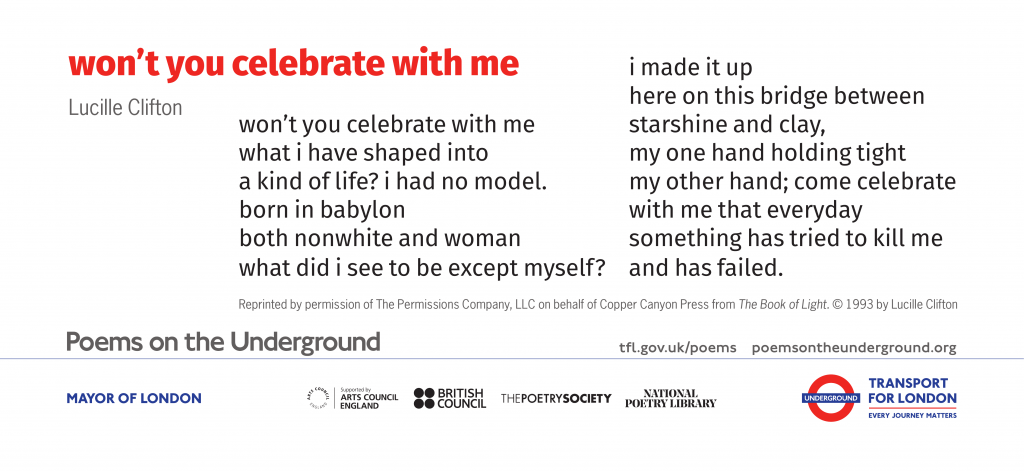
won’t you celebrate with me by Lucille Clifton won’t you celebrate with me what i have shaped into a kind of life? i had no model. born in babylon both nonwhite and woman what did i see to be except myself? i made it up here on this bridge between starshine and clay, my one hand holding tight my other hand; come celebrate with me that everyday something has tried to kill me and has failed. from The Book of Light. Copyright © 1993 by Lucille Clifton. Reprinted with the permission of The Permissions Company, LLC on behalf of Copper Canyon Press

Won’t you celebrate with me by Lucille Clifton read by Valerie Bloom

from The Song of Solomon, The King James Bible (1611) ' My beloved spake, and said unto me, Rise up, my Love, my fair one, and come away. For lo, the winter is past, the rain is over, and gone. The flowers appear on the earth, the time of the singing of birds is come, and the voice of the turtle is heard in our land. The fig tree putteth forth her green figs, and the vines with the tender grape give a good smell. Arise, my love, my fair one, and come away. '

from The Song of Solomon read by Valerie Bloom

Spring Poems on the Underground

Seed by Paula Meehan 'The first warm day of spring and I step out into the garden from the gloom of a house where hope had died to tally the storm damage, to seek what may have survived. And finding some forgotten lupins I’d sown from seed last autumn holding in their fingers a raindrop each like a peace offering, or a promise, I am suddenly grateful and would offer a prayer if I believed in God. But not believing, I bless the power of seed, its casual, useful persistence, and bless the power of sun, its conspiracy with the underground, and thank my stars the winter’s ended.'

Seed read by Paula Meehan

Wet Evening in April by Patrick Kavanagh 'The birds sang in the wet trees And I listened to them it was a hundred years from now And I was dead and someone else was listening to them. But I was glad I had recorded for him The melancholy.'

Wet Evening in April by Patrick Kavanagh read by Roger McGough

Kathleen Raine, The Very Leaves of the Acacia-Tree are London ' The very leaves of the acacia-tree are London; London tap-water fills out the fuchsia buds in the back garden, Blackbirds pull London worms out of the sour soil, The woodlice, centipedes, eat London, the wasps even. London air through stomata of myriad leaves And million lungs of London breathes. Chlorophyll and haemoglobin do what life can To purify, to return this great explosion To sanity of leaf and wing. Gradual and gentle the growth of London pride, And sparrows are free of all the time in the world: Less than a window-pane between.'

The Very Leaves of the Acacia Tree are London read by Cicely Herbert

The Trees ,Philip Larkin 1997 poems on the Underground poster 'The trees are coming into leaf Like something almost being said; The recent buds relax and spread, Their greenness is a kind of grief. Is it that they are born again And we grow old? No, they die too. Their yearly trick of looking new Is written down in rings of grain. Yet still the unresting castles thresh In fullgrown thickness every May. Last year is dead, they seem to say, Begin afresh, afresh, afresh.'

Listen to The Trees by Philip Larkin read by Wendy Cope

Opening lines of The Canterbury Tales Geoffrey Chaucer (1340?-1400) 'Whan that Aprill with his shoures soote The droghte of March hath perced to the roote, And bathed every veyne in swich licour Of which vertu engendred is the flour; Whan Zephirus eek with his sweete breeth Inspired hath in every holt and heeth The tendre croppes, and the yonge sonne Hath in the Ram his half cours yronne, And smale foweles maken melodye That slepen all the nyght with open ye (So priketh hem nature in hir corages) Thanne longen folk to goon on pilgrimages... '
25th April 1974, Sophie de Mello Breyner tr.Ruth Fainlight, 'This is the dawn I was waiting for The first day whole and pure When we emerged from night and silence Alive into the substance of time'
I sing of a Maiden Anon (early 15th century )' I sing of a maiden that is makeless King of all kings to her son she chose he came also still there his mother was as dew in April that falleth on the grass he came also still to his mother's bower as dew in April that falleth on the flower he came also still there his mother lay as dew in April that falleth on the spray mother and maiden was never none but she well may such a lady God's mother be'

Celebrating Shakespeare’s birthday

Ariel's Song (from The Tempest), William Shakespeare ( 1564-1616) Illustration by Arthur Rackham Poems on the Underground Poster 1993 Poster 'Full fathom five thy father lies, Of his bones are coral made: Those are pearls that were his eyes, Nothing of him that doth fade, But doth suffer a sea-change Into something rich, and strange: Sea-nymphs hourly ring his knell- Hark! now I hear them, Ding-dong, bell.'

Listen to Ariel’s Song read by Christopher Logue

Sonnet 116, William Shakespeare 1998 Poster Poems on the Underground ' Let me not to the marriage of true minds Admit impediments; love is not love Which alters when it alteration finds, or bends with the remover to remove'

Listen to Sonnet 116 read by John Hegley

Sonnet 29, William Shakespeare 'When, in disgrace with fortune and men’s eyes, I all alone beweep my outcast state, And trouble deaf heaven with my bootless cries, And look upon myself and curse my fate, Wishing me like to one more rich in hope, Featured like him, like him with friends possessed, Desiring this man’s art and that man’s scope, With what I most enjoy contented least; Yet in these thoughts myself almost despising, Haply I think on thee, and then my state, (Like to the lark at break of day arising From sullen earth) sings hymns at heaven’s gate; For thy sweet love remembered such wealth brings, That then I scorn to change my state with kings.'

Listen to Sonnet 29 read by James Berry

New Poems February 2026

New Poems Autumn 2025

New Poems Summer 2025

New Poems Spring 2025

Poems from March 2026

Poems from February 2026

Poems from January 2026

Poems from 2025

Poems from 2024

poems from 2023

poems from 2022

poems from 2021

Poems from 2020

Love Poems Leaflet

February Poems Leaflet

War Poems on the Underground leaflet

Poems on the Underground at the Scottish Poetry Library