Poems of the Week from 2025

from Piers Plowman by William Langland (c. 1332-1400) "After sharp showers," said Peace, "the sun shines brightest; No weather is warmer than after watery clouds, Nor any love dearer, or more loving friends Than after war and woe, when Love and Peace are masters. There was never war in this world, or wickedness so keen, That Love, if he liked, could not turn to laughter, And Peace, through patience, put an end to all perils." Illustration "God spede ye plough", Trinity MS R.3.14, f.1v reprinted by permission of the Master and Fellows of Trinity College Cambridge
Now winter nights enlarge by Thomas Campion 'Now winter nights enlarge The number of their hours, And clouds their storms discharge Upon the airy towers. Let now the chimneys blaze And cups o’erflow with wine: Let well-tun'd words amaze With harmony divine. Now yellow waxen lights Shall wait on honey Love, While youthful Revels, Masks, and Courtly sights, Sleep’s leaden spells remove. This time doth well dispense With lovers’ long discourse; Much speech hath some defence, Though beauty no remorse. All do not all things well; Some measures comely tread; Some knotted Riddles tell; Some Poems smoothly read. The summer hath his joys, And Winter his delights; Though love and all his pleasures are but toys, They shorten tedious nights.'
from Inversnaid by Gerard Manley Hopkins ' What would the world be, once bereft Of wet and of wildness? Let them be left, O let them be left, wildness and wet; Long live the weeds and the wilderness yet.'
Leaf , Seán Hewitt from Tongues of Fire 'For woods are forms of grief grown from the earth. For they creak with the weight of it. For each tree is an altar to time. For the oak, whose every knot guards a hushed cymbal of water. For how the silver water holds the heavens in its eye. For the axletree of heaven and the sleeping coil of wind and the moon keeping watch. For how each leaf traps light as it falls. For even in the nighttime of life it is worth living, just to hold it.'
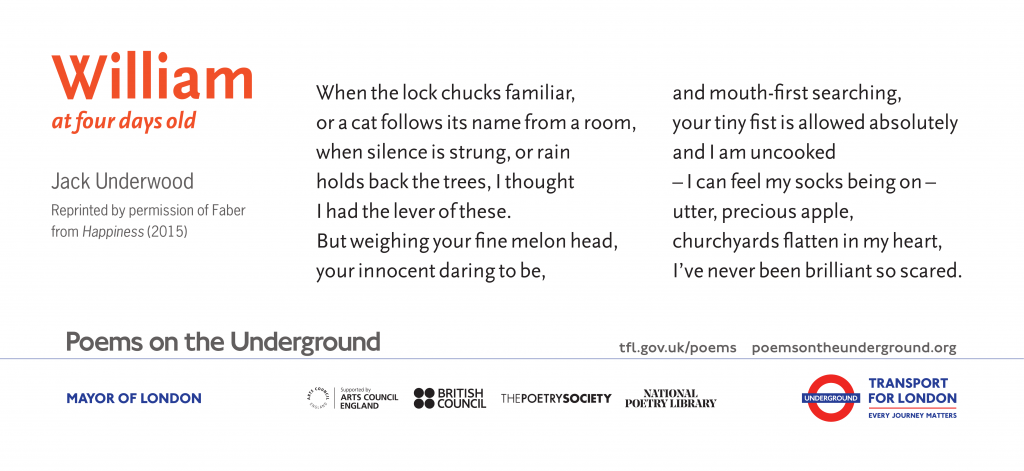
William at four days old by Jack Underwood When the lock chucks familiar, or a cat follows its name from a room, when silence is strung, or rain holds back the trees, I thought I had the lever of these. But weighing your fine melon head, your innocent daring to be, and mouth-first searching, your tiny fist is allowed absolutely and I am uncooked -- I can feel my socks being on – utter, precious apple, churchyards flatten in my heart, I’ve never been brilliant so scared. Reprinted by permission of Faber from Happiness (2015)
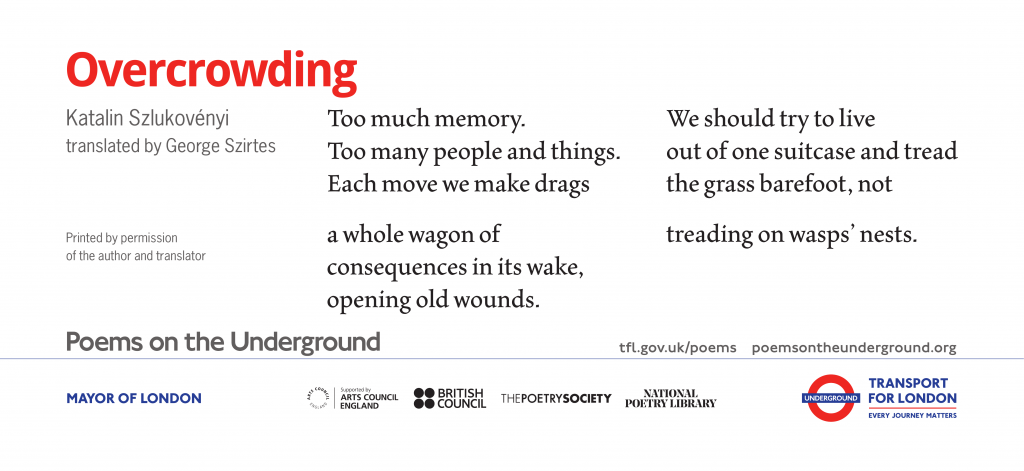
Overcrowding by Katalin Szlukovényi translated by George Szirtes Too much memory. Too many people and things. Each move we make drags a whole wagon of consequences in its wake, opening old wounds. We should try to live out of one suitcase and tread the grass barefoot, not treading on wasps’ nests. Reprinted by permission of the author and translator

Overcrowding by Katalin Szlukovényi read by George Szirtes
I Take Into My Arms More Than I Can Bear To Hold by Janet Frame I take into my arms more than I can bear to hold I am toppled by the world a creation of ladders, pianos, stairs cut into the rock a devouring world of teeth where even the common snail eats the heart out of a forest as you and I do, who are human, at night yet still I take into my arms more than I can bear to hold Reprinted by permission of The Wylie Agency from Storms Will Tell: Selected Poems (Bloodaxe Books 2008)

Copyright © Janet Frame 2006

I take into my arms more than I can bear to hold by Janet Frame read by Imtiaz Dharker

Everyone Sang by Siegfried Sassoon Poems on the Underground 1999 poster 'Everyone suddenly burst out singing; And I was filled with such delight As prisoned birds must find in freedom, Winging wildly across the white Orchards and dark-green fields; on - on - and out of sight. Everyone's voice was suddenly lifted; And beauty came like the setting sun: My heart was shaken with tears; and horror Drifted away ... O, but Everyone Was a bird; and the song was wordless; the singing will never be done.'

Everyone Sang by Siegfried Sassoon read by Adrian Mitchell
Days of November 2009 by Sheenagh Pugh Short days, long shadows: sun rising low skims the hill. Mending, making good, days full of outdoor jobs, folk racing to finish before dark, before winter. Angled light, always on the edge of leaving. These days when every little thing feels urgent, unmissable, when all you want is to hold on to a lit rack of cirrus, the taste of woodsmoke catching your throat, a sleek seal slipping back under, the farewell of geese, scribbled in black arrows. Reprinted by permission of Seren from Short Days, Long Shadows (2014)

Days of November 2009 read by Sheenagh Pugh
won’t you celebrate with me by Lucille Clifton won’t you celebrate with me what i have shaped into a kind of life? i had no model. born in babylon both nonwhite and woman what did i see to be except myself? i made it up here on this bridge between starshine and clay, my one hand holding tight my other hand; come celebrate with me that everyday something has tried to kill me and has failed. from The Book of Light. Copyright © 1993 by Lucille Clifton. Reprinted with the permission of The Permissions Company, LLC on behalf of Copper Canyon Press

won’t you celebrate with me by Lucille Clifton read by Valerie Bloom

Benediction, James Berry 'Thanks to the ear that someone may hear Thanks to seeing that someone may see'

Benediction written and read by James Berry

from We Refugees We can all be refugees Sometimes it only takes a day, Sometimes it only takes a handshake Or a paper that is signed. We all came from refugees Nobody simply just appeared, Nobody’s here without a struggle, And why should we live in fear Of the weather or the troubles? We all came here from somewhere Benjamin Zephaniah from We Refugees Reprinted by permission of Penguin Books Limited from Wicked World (Puffin, 2000).

We Refugees by Benjamin Zephaniah read by Nii Ayikwei Parkes
Loving the rituals by Palladas (4th century AD) tr. Tony Harrison Poems on the Underground 1999 1,000 years of poetry in English ‘Loving the rituals that keep men close, Nature created means for friends apart: pen, paper, ink, the alphabet, signs for the distant and disconsolate heart.’
from To Autumn, John Keats ' Season of mists and mellow fruitfulness, Close bosom-friend of the maturing sun; Conspiring with him how to load and bless With fruit the vines that round the thatch-eves run; To bend with apples the moss’d cottage-trees, And fill all fruit with ripeness to the core; To swell the gourd, and plump the hazel shells With a sweet kernel; to set budding more, And still more, later flowers for the bees, Until they think warm days will never cease, For Summer has o’er-brimmed their clammy cells.'
Ode to the West Wind by P. B. Shelley 'O wild West Wind, thou breath of Autumn's being, Thou, from whose unseen presence the leaves dead Are driven, like ghosts from an enchanter fleeing, Yellow, and black, and pale, and hectic red, Pestilence-stricken multitudes; O Thou, Who chariotest to their dark wintry bed The wingèd seeds, where they lie cold and low, Each like a corpse within its grave, until Thine azure sister of the Spring shall blow Her clarion o’er the dreaming earth, and fill (Driving sweet buds like flocks to feed in air) With living hues and odours plain and hill: Wild Spirit, which art moving everywhere; Destroyer and Preserver; hear, O hear! '
For the Life of This Planet, Grace Nichols ‘ The way the red sun surrenders its wholeness to curving ocean bit by bit. The way curving ocean gives birth to the birth of stars in the growing darkness, wearing everything in its path to cosmic smoothness’
from Autumn Journal, Louis MacNeice ‘September has come, it is hers Whose vitality leaps in the autumn, Whose nature prefers Trees without leaves and a fire in the fireplace . . .’
Buses on the Strand, R. P. Lister ‘The Strand is beautiful with buses, Fat and majestical in form, Red like tomatoes in their trusses In August, when the sun is warm.’
Midsummer, Tobago, Derek Walcott 'Broad sun-stoned beaches. White heat. A green river. A bridge, scorched yellow palms from the summer-sleeping house drowsing through August. Days I have held, days I have lost, days that outgrow, like daughters, my harbouring arms.'
The Morning After (August 1945), Tony Harrison ' The fire left to itself might smoulder weeks. Phone cables melt. Paint peels from off back gates. Kitchen windows crack; the whole street reeks of horsehair blazing. Still it celebrates.'
Moment in a Peace March, Grace Nichols ‘A holy multitude pouring Moment in a Peace March through the gates of Hyde Park – A great hunger repeated in cities all over the world’
Green the land of my poem, Mahmoud Darwish ‘Green the land of my poem is green and high Slowly I tell it slowly with the grace of a seagull riding the waves on the book of water I bequeath it written down to the one who asks to whom shall we sing when salt poisons the dew?’
If Bach Had Been a Beekeeper, Charles Tomlinson ' If Bach Had Been a Beekeeper he would have heard all those notes suspended above one another in the air of his ear as the undifferentiated swarm returning to the exact hive to place in the hive, topping up the cells with the honey of C major, food for the listening generations, key to their comfort and solace of their distress as they return and return to those counterpointed levels of hovering wings where movement is dance and the air itself a scented garden'
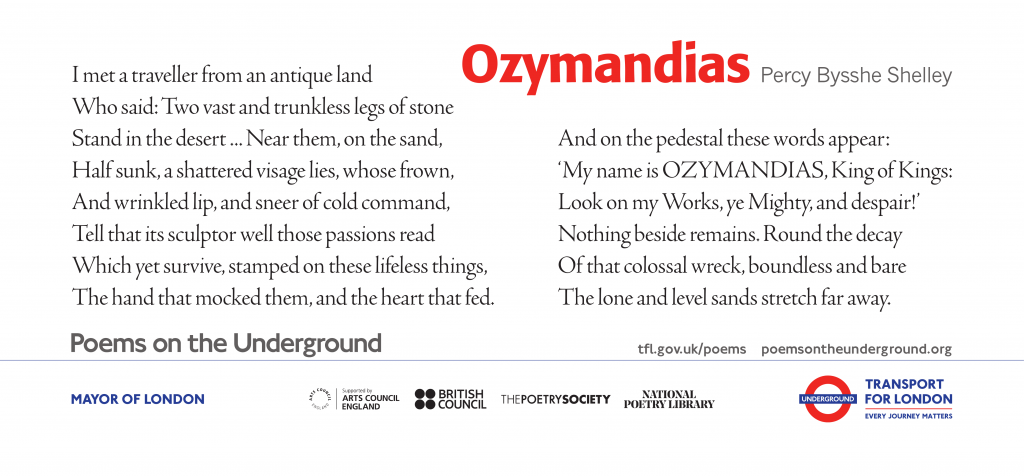
Ozymandias by Percy Bysshe Shelley 'I met a traveller from an antique land Who said: Two vast and trunkless legs of stone Stand in the desert . . . Near them, on the sand, Half sunk, a shattered visage lies, whose frown, And wrinkled lip, and sneer of cold command, Tell that its sculptor well those passions read Which yet survive, stamped on these lifeless things, The hand that mocked them, and the heart that fed. And on the pedestal these words appear: 'My name is OZYMANDIAS, King of Kings: Look on my Works, ye Mighty, and despair!' Nothing beside remains. Round the decay Of that colossal wreck, boundless and bare The lone and level sands stretch far away.'

Ozymandias by Percy Bysshe Shelley read by Gavin Ewart

Naima for John Coltrane, Kamau Brathwaite 'Propped against the crowded bar he pours into the curved and silver horn his old unhappy longing for a home'

Naima by Kamau Brathwaite read by Valerie Bloom

Map of the New World: Archipelagoes , Derek Walcott ' At the end of this sentence, rain will begin. At the rain's edge, a sail. Slowly the sail will lose sight of islands; into a mist will go the belief in harbours of an entire race. The ten-years war is finished. Helen's hair, a grey cloud. Troy, a white ashpit by the drizzling sea. The drizzle tightens like the strings of a harp. A man with clouded eyes picks up the rain and plucks the first line of the Odyssey.'

Map of the New World : Archipelagoes by Derek Walcott read by John Glenday
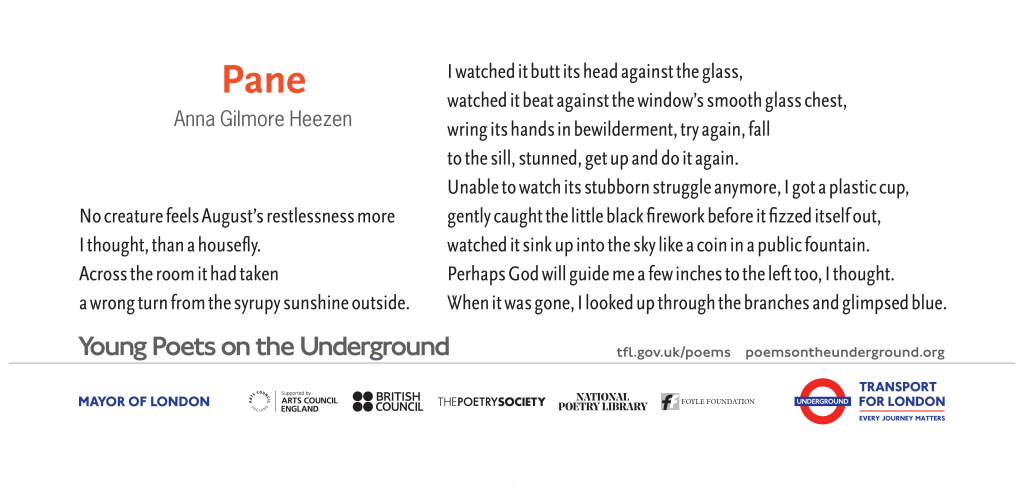
Pane No creature feels August’s restlessness more I thought, than a housefly. Across the room it had taken a wrong turn from the syrupy sunshine outside. I watched it butt its head against the glass, watched it beat against the window’s smooth glass chest, wring its hands in bewilderment, try again, fall to the sill, stunned, get up and do it again. Unable to watch its stubborn struggle anymore, I got a plastic cup, gently caught the little black firework before it fizzed itself out, watched it sink up into the sky like a coin in a public fountain. Perhaps God will guide me a few inches to the left too, I thought. When it was gone, I looked up through the branches and glimpsed blue. Anna Gilmore Heezen Young Poets on the Underground

Pane read by Anna Gilmore Heezen

And if I speak of Paradise, Roger Robinson ‘And if I speak of Paradise then I’m speaking of my grandmother who told me to carry it always on my person, concealed, so no one else would know but me.’

A Portable Paradise by Roger Robinson read by Imtiaz Dharker
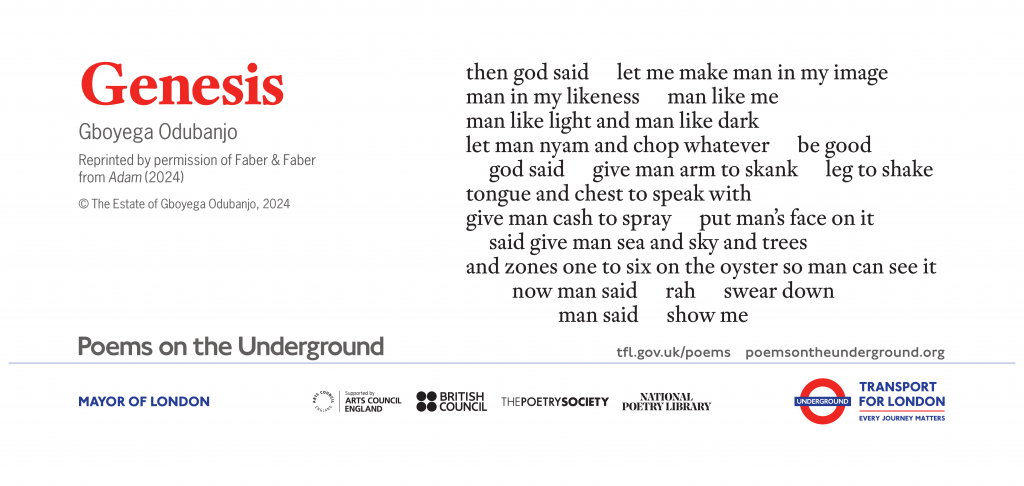
Genesis then god said   let me make man in my image man in my likeness   man like me man like light and man like dark let man nyam and chop whatever   be good   god said   give man arm to skank   leg to shake tongue and chest to speak with give man cash to spray   put man’s face on it   said give man sea and sky and trees and zones one to six on the oyster so man can see it     now man said   rah   swear down        man said   show me Gboyega Odubanjo Reprinted by permission of Faber & Faber from Adam (2024) © The Estate of Gboyega Odubanjo, 2024
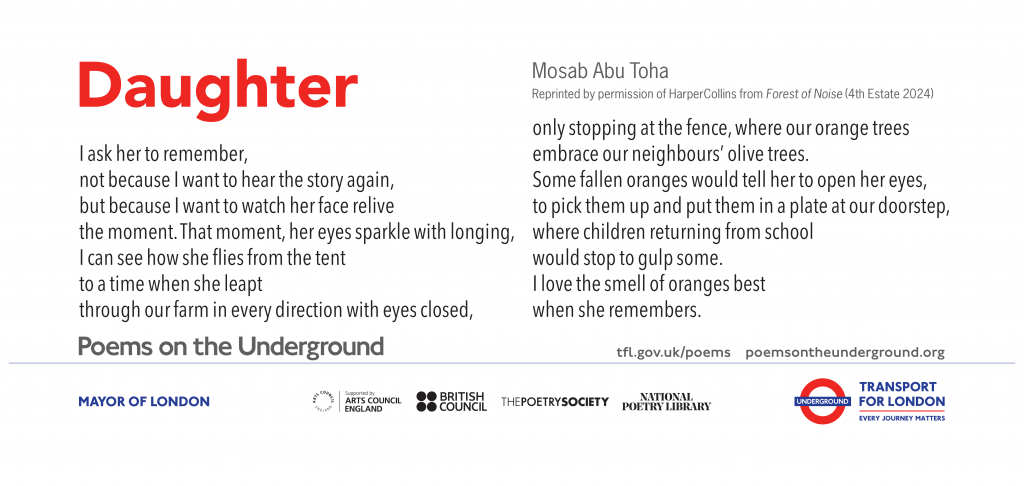
Daughter I ask her to remember, not because I want to hear the story again, but because I want to watch her face relive the moment. That moment, her eyes sparkle with longing, I can see how she flies from the tent to a time when she leapt through our farm in every direction with eyes closed, only stopping at the fence, where our orange trees embrace our neighbours’ olive trees. Some fallen oranges would tell her to open her eyes, to pick them up and put them in a plate at our doorstep, where children returning from school would stop to gulp some. I love the smell of oranges best when she remembers. Mosab Abu Toha Reprinted by permission of HarperCollins from Forest of Noise (4th Estate 2024)
Delay, Elizabeth Jennings, 1988 Poems on the Underground poster ‘The radiance of the star that leans on me Was shining years ago. The light that now Glitters up there my eyes may never see, And so the time lag teases me with how Love that loves now may not reach me until Its first desire is spent. The star's impulse Must wait for eyes to claim it beautiful And love arrived may find us somewhere else.'

Delay by Elizabeth Jennings read by Roger McGough

Stars & Planets by Norman MacCaig read by Roger McGough

The Tyger, William Blake 'Tyger Tyger, burning bright, In the forests of the night; What immortal hand or eye, Could frame thy fearful symmetry? In what distant deeps or skies Burnt the fire of thine eyes! On what wings dare he aspire? What the hand, dare seize the fire? And what shoulder, & what art, Could twist the sinews of thy heart? And when thy heart began to beat, What dread hand? & what dread feet? What the hammer? what the chain, In what furnace was thy brain? What the anvil? what dread grasp, Dare its deadly terrors clasp? When the stars threw down their spears And water'd heaven with their tears: Did he smile his work to see? Did he who made the Lamb make thee? Tyger Tyger burning bright, In the forests of the night: What immortal hand or eye, Dare frame thy fearful symmetry?'

The Tyger by William Blake read by James Berry
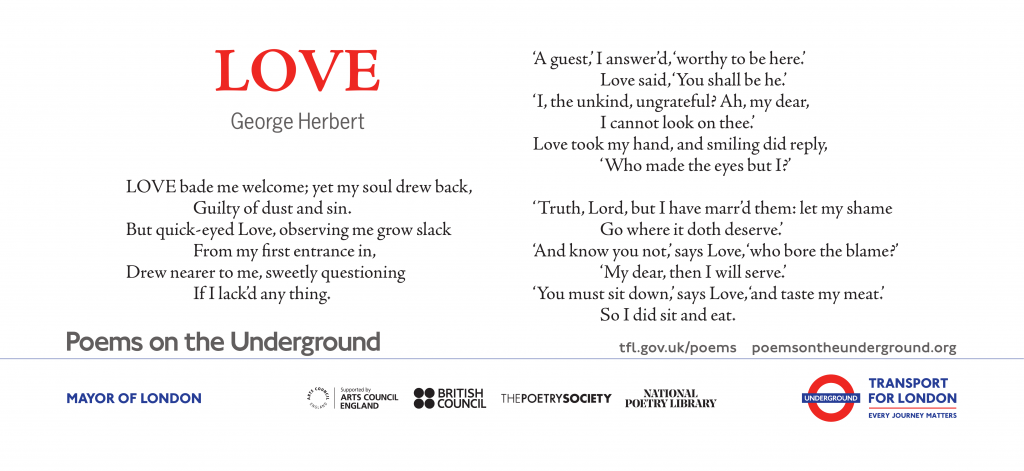
Love LOVE bade me welcome; yet my soul drew back, Guilty of dust and sin. But quick-eyed Love, observing me grow slack From my first entrance in, Drew nearer to me, sweetly questioning If I lack’d anything. ‘A guest,’ I answer’d, ‘worthy to be here:’ Love said, ‘You shall be he.’ ‘I, the unkind, ungrateful? Ah, my dear, I cannot look on Thee.’ Love took my hand and smiling did reply, ‘Who made the eyes but I?’ ‘Truth, Lord; but I have marr’d them: let my shame Go where it doth deserve.’ ‘And know you not,’ says Love, ‘Who bore the blame?’ ‘My dear, then I will serve.’ ‘You must sit down,’ says Love, ‘and taste my meat.’ So I did sit and eat. George Herbert

Love by George Herbert read by Paula Meehan
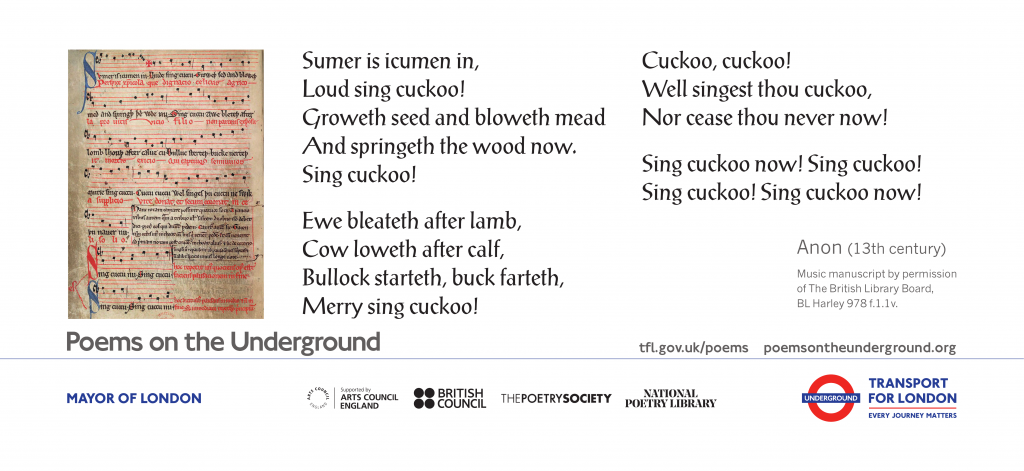
‘Sumer is icumen in’ Sumer is icumen in Loud sing cuckoo! Groweth seed and bloweth mead And springeth the wood now, Sing cuckoo! Ewe bleateth after lamb, Cow loweth after calf, Bullock starteth, buck farteth, Merry sing cuckoo! Cuckoo, cuckoo! Well singest thou cuckoo, Nor cease thou never now! Sing cuckoo now, sing cuckoo! Sing cuckoo, sing cuckoo now! Anon (13th century) Music manuscript by permission of The British Library Board, BL Harley 978f.1.1v

Sumer is Icumen in read by Nii Ayikwei Parkes

Much Madness is Divinest Sense, Emily Dickinson, Much Madness is divinest Sense- To a discerning Eye- Much Sense- the starkest Madness- 'Tis the Majority In this, as All, Prevail- Assent- and you are sane- Demur- you're straightway dangerous- And handled with a Chain-''

Much Madness is Divinest Sense by Emily Dickinson read by George Szirtes

Sonnet 29, William Shakespeare 'When, in disgrace with fortune and men’s eyes, I all alone beweep my outcast state, And trouble deaf heaven with my bootless cries, And look upon myself and curse my fate, Wishing me like to one more rich in hope, Featured like him, like him with friends possessed, Desiring this man’s art and that man’s scope, With what I most enjoy contented least; Yet in these thoughts myself almost despising, Haply I think on thee, and then my state, (Like to the lark at break of day arising From sullen earth) sings hymns at heaven’s gate; For thy sweet love remembered such wealth brings, That then I scorn to change my state with kings.'

Listen to Sonnet 29 read by James Berry

Kathleen Raine, The Very Leaves of the Acacia-Tree are London ' The very leaves of the acacia-tree are London; London tap-water fills out the fuchsia buds in the back garden, Blackbirds pull London worms out of the sour soil, The woodlice, centipedes, eat London, the wasps even. London air through stomata of myriad leaves And million lungs of London breathes. Chlorophyll and haemoglobin do what life can To purify, to return this great explosion To sanity of leaf and wing. Gradual and gentle the growth of London pride, And sparrows are free of all the time in the world: Less than a window-pane between.'

The Very Leaves of the Acacia-Tree are London by Kathleen Raine read by Cicely Herbert

Spooner Goes Under, Brian O’Connor ‘Stamp Head Wedge Air Stooge Greet Shammer Myth Flak Briars Straker Beat’

 Spooner Goes Under read by Brian O’Connor

Guinep, Olive Senior 'Our mothers have a thing about guinep: Mind you don't eat guinep in your good clothes. It will stain them.'

Guinep by Olive Senior read by Valerie Bloom

Love after Love by Derek Walcott ' The time will come when, with elation, you will greet yourself arriving at your own door, in your own mirror, and each will smile at the other's welcome, and say, sit here. Eat. You will love again the stranger who was your self. Give wine. Give bread. Give back your heart to itself, to the stranger who has loved you all your life, whom you ignored for another, who knows you by heart. Take down the love letters from the bookshelf, the photographs, the desperate notes, peel your own image from the mirror. Sit. Feast on your life.' Reprinted by permission of Faber from Collected Poems (1986)

Love after Love by Derek Walcott read by Marjorie Lotfi

This Moment, Eavan Boland 'A neighbourhood. At dusk. Things are getting ready to happen out of sight. Stars and moths. And rinds slanting around fruit. But not yet. One tree is black. One window is yellow as butter. A woman leans down to catch a child who has run into her arms this moment. Stars rise. Moths flutter. Apples sweeten in the dark.''

This Moment by Eavan Boland read by John Glenday

Like A Beacon, Grace Nichols 2009 Poster 'In London every now and then I get this craving for my mother’s food I leave art galleries in search of plantains saltfish/sweet potatoes I need this link I need this touch of home swinging my bag like a beacon against the cold'

Like a Beacon by Grace Nichols read by Merle Collins
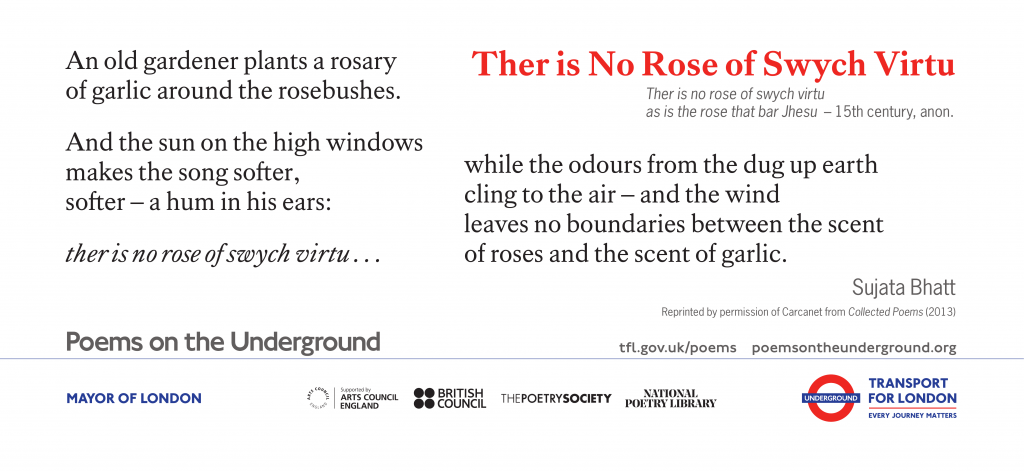
Ther is No Rose of Swych Virtu Ther is no rose of swych virtu as is the rose that bar Jhesu -- 15th century, anon. An old gardener plants a rosary of garlic around the rosebushes. And the sun on the high windows makes the song softer, softer – a hum in his ears: ther is no rose of swych virtu . . . while the odours from the dug up earth cling to the air – and the wind leaves no boundaries between the scent of roses and the scent of garlic. Sujata Bhatt Reprinted by permission of Carcanet from Collected Poems (2013)

Ther is No Rose of Swych Virtu by Sujata Bhatt read by Marjorie Lotfi

The Sonnets, Michael Longley 'The soldier-poet packed into his kitbag His spine-protector, socks, soap, latherbrush (Though he was not then a regular shaver)'

The Sonnets by Michael Longley read by Ian Duhig

Sonnet 116, William Shakespeare 1998 Poster Poems on the Underground ' Let me not to the marriage of true minds Admit impediments; love is not love Which alters when it alteration finds, or bends with the remover to remove'

Sonnet 116 by William Shakespeare read by John Hegley

Free, Merle Collins 'Born free to be caught and fashioned and shaped and freed to wander within a caged dream of tears'

Free read by Merle Collins

Michael Longley RIP

Harmonica by Michael Longley read by Ian Duhig

Up in the Morning Early ,Robert Burns 'Cauld blaws the wind frae east to west, The drift is driving sairly; Sae loud and shrill's I hear the blast, I'm sure it's winter fairly.'

Up in the Morning Early by Robert Burns read by Gerard Benson

Gavin Ewart , A 14 year old Convalescent Cat in the Winter Poems on the Underground 1995 ' I want him to have another living summer, to lie in the sun and enjoy the douceur de vivre- because the sun, like golden rum in a rummer, is what makes an idle cat un tout petit peu ivre- I want him to lie stretched out, contented, revelling in the heat, his fur all dry and warm, an Old Age Pensioner, retired, resented by no one, and happinesses in a beelike swarm to settle on him – postponed for another season that last fated hateful journey to the vet from which there is no return (and age the reason), which must come soon – as I cannot forget''

A 14 Year Old Convalescent Cat in Winter read by Gavin Ewart

Time to be slow, John O’Donohue ‘This is the time to be slow, Lie low to the wall Until the bitter weather passes’

This is the Time to be Slow

Excerpt from For the Break-Up of a Relationship,  from Benedictus (Europe) / To Bless the Space Between Us (US) by John O’Donohue

Auld Lang Syne by Robert Burns 'Should auld acquaintance be forgot, And never brought to min'? Should auld acquaintance be forgot, And days o' auld lang syne? We twa hae run about the braes, And pu'd the gowans fine; But we've wander'd mony a weary foot Sin' auld lang syne. We twa hae paidl't i' the burn, From mornin sun till dine; But seas between us braid hae roar'd Sin' auld lang syne. Chorus: For auld lang syne, my dear, For auld lang syne, We'll tak a cup o' kindness yet For auld lang syne.'
from In Memoriam by Alfred, Lord Tennyson Poems on the Underground 1000 years of poetry in English 1999 'Ring out, wild bells, to the wild sky, The flying cloud, the frosty light: The year is dying in the night; Ring out, wild bells, and let him die. Ring out the old, ring in the new, Ring, happy bells, across the snow: The year is going, let him go; Ring out the false, ring in the true. Ring out the grief that saps the mind For those that here we see no more; Ring out the feud of rich and poor, Ring in redress to all mankind.'